
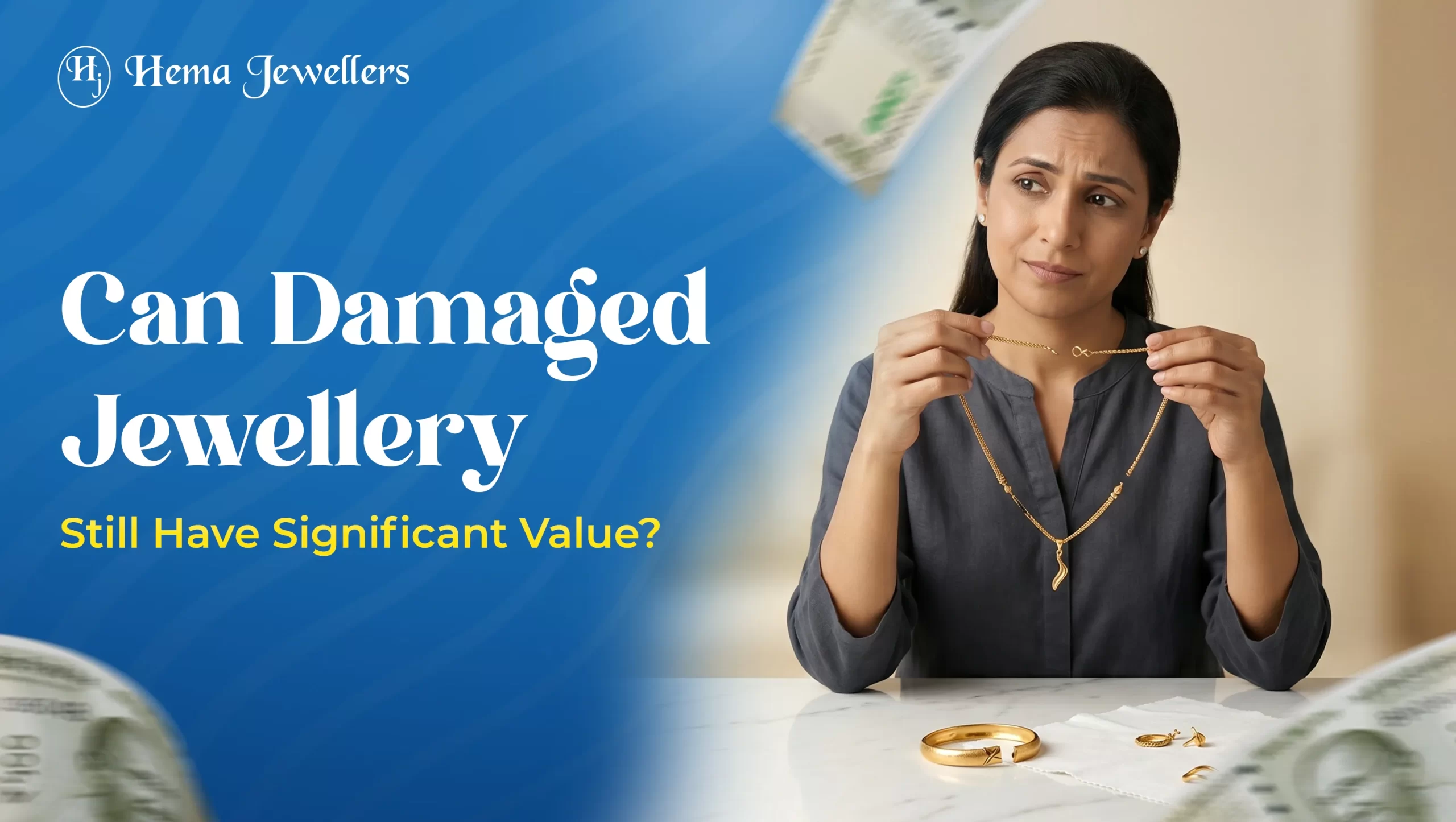
That assumption is wrong. And it is costing families real money every year they let it sit.
Damaged gold jewellery retains its metal value completely. A broken chain is not worth less per gram than an intact one. A bent bangle has not lost its karat. A ring missing its stone still contains every gram of gold it always did. Understanding this single fact opens up a meaningful source of liquidity that most households do not realize they are sitting on.
Table Of Contents:
- Why Damage Does Not Diminish Gold’s Core Value
- The Most Common Types of Damaged Gold and What to Expect
- The Stone Deduction: Understanding What Changes With Damage
- Pledged Gold That Has Been Damaged: A Special Consideration
- What Buyers Actually Do With Damaged Gold
- How to Prepare Damaged Pieces Before Visiting a Buyer
- Why Families Wait Too Long to Sell Damaged Gold
- How Hema Jewellers Handles Damaged Gold With Complete Fairness
- FAQs
Why Damage Does Not Diminish Gold’s Core Value
Gold’s value is determined by two things and two things only: weight and purity. Neither of these changes when a piece of jewellery is damaged. A clasp that snaps does not reduce the gold content of the chain it was attached to. A stone falling out of a ring leaves the gold setting fully intact. A crack in a bangle does not alter its karat composition in any way.
This is fundamentally different from how damage works with other valuables. A cracked smartphone loses significant resale value. A scratched luxury watch commands less at auction. A torn piece of clothing is worth nothing. Gold does not follow this pattern because it is not being sold for its form. It is being sold for its material, and that material is unchanged regardless of what the jewellery has been through.
When you bring damaged pieces to the best gold buyers in Bangalore, they assess your gold exactly the same way they would assess a pristine, unworn piece. The scale records the same weight. The XRF scanner reads the same karat. The live market rate applies identically. The only difference is in how the piece looks, and appearance has no column in the gold pricing formula.
The Most Common Types of Damaged Gold and What to Expect
Not all damage is the same, and understanding how different types of damage interact with the selling process helps set accurate expectations before your visit.
Broken clasps and chains are among the most common forms of damage that send jewellery into storage. A broken chain is often assumed to be worthless because it cannot be worn. In reality, it is one of the cleanest pieces to sell because it rarely contains embedded stones and its gold content is entirely straightforward to assess. The break itself is irrelevant to valuation.
Bent or misshapen pieces such as bangles, kadas, and rings that have lost their original form through pressure or accident retain every gram of their gold. The bending has not removed material. It has only changed the shape, and shape is not a pricing variable at any reputable buyer. Bringing a bent bangle to the best place to sell gold in Bangalore yields the same result as bringing a perfectly round one of identical weight and karat.
Stone-missing pieces require a slightly more nuanced assessment. When a piece originally had a stone and that stone is now absent, the stone’s weight is no longer present to be deducted. In some cases this actually simplifies the valuation because there is no stone deduction calculation required. The gold setting remains and is assessed purely on its metal weight and purity.
Scratched or worn surfaces have absolutely no impact on gold’s value. Surface wear is cosmetic. The metal beneath remains chemically and compositionally identical regardless of how many years it has been worn or how much it has scratched against other surfaces in a jewellery box.
Partially melted or fire-damaged gold is a less common scenario but one that deserves mention. Even gold that has been exposed to fire, which may have caused solder points to melt or surface finish to alter, retains its elemental gold content. Fire does not destroy gold. It may alter its form, but the metal itself survives, and a skilled buyer can assess and purchase even pieces in this condition.
The Stone Deduction: Understanding What Changes With Damage
When jewellery arrives at a buyer with its stones intact, the stone weight is subtracted from the gross weight before pricing. This is standard and legitimate. When a stone is already missing, the gross weight reflects only gold and any remaining metal components. There is no deduction required because there is nothing left to subtract.
This means that a ring that originally had a diamond but lost it will in some cases be priced on a cleaner net weight than it would have been with the stone present. The absence of the stone does not reduce the gold value. It simply removes a variable from the calculation.
Where sellers need to be attentive is with pieces that still have stones in compromised settings. A loose stone that might fall during assessment should be flagged upfront.
Reputable buyers will secure or remove the stone before weighing, ensuring neither party loses track of any component during the transaction.
Pledged Gold That Has Been Damaged: A Special Consideration
A category of damaged gold that deserves separate attention is jewellery that was pledged to a lender and returned in a condition worse than when it was deposited. This happens more often than most people realize. Improper storage at lending institutions, shared vault conditions, or careless handling during repeated assessment cycles can result in scratches, bent settings, or loosened stones by the time the pledged piece is returned to its owner.
Families who retrieve their gold from lenders and discover damage sometimes assume the piece has lost significant value and delay selling. This delay costs them both time and, in some cases, the benefit of favorable market conditions. The damage sustained during the pledge period does not alter the metal value of the piece. Working with pledged gold buyers in Bangalore who understand this distinction ensures that families receive a fair assessment based on the gold’s actual content rather than its compromised appearance.
If damage during the pledge period is significant, families may also have grounds to raise a complaint with the lending institution, but that is a separate process that should not delay the decision to convert the gold to its rightful cash value.
What Buyers Actually Do With Damaged Gold
Understanding the downstream process helps explain why buyers are entirely indifferent to a piece’s condition. When a reputable gold buyer purchases damaged jewellery, the piece is eventually melted down and refined. In this process, the physical form disappears entirely. The clasp that was broken, the surface that was scratched, the setting that lost its stone, none of it survives the refining process. What survives is pure gold, in exact proportion to the karat content of the original piece.
This is why the condition of the jewellery is irrelevant at the point of purchase. The buyer knows that whatever arrives at their counter will be reduced to its elemental form during refining. They are not buying a wearable object. They are buying a specific weight of a specific purity of metal, and damage does not alter either of those variables.
How to Prepare Damaged Pieces Before Visiting a Buyer
A few minutes of simple preparation before your visit ensures the process goes smoothly and that you have the context to follow every step of the assessment.
Gather all damaged pieces together rather than visiting multiple times. Buyers assess everything in a single session, and bringing all your damaged gold at once gives you a complete picture of its combined value. Keep any stones that have already fallen out in a small sealed bag and bring them along. While loose stones typically hold minimal value at a gold buyer, having them present avoids any ambiguity about what was part of the original piece. If any of your damaged pieces are BIS hallmarked, note which ones. Hallmarked pieces are assessed faster because their purity is already certified. For non-hallmarked damaged pieces, XRF testing determines purity accurately and non-destructively regardless of the piece’s condition.
One thing that genuinely does not help is attempting repairs before selling. Having a broken clasp fixed or a bent bangle reshaped before visiting a buyer adds cost without adding a single rupee to the selling price. Buyers do not pay more for repaired pieces. They pay for metal content, and a repaired piece has the same metal content as a broken one.
Why Families Wait Too Long to Sell Damaged Gold
The most common reason damaged gold stays unsold for years is a false assumption layered over another false assumption. The first is that damage reduces value. The second is that even if value remains, the process of selling damaged gold must be complicated or different from selling intact pieces.
Neither is true. The process is identical. The valuation formula is identical. The timeline is identical. A broken chain takes no longer to assess than a perfect one. A bent bangle does not require additional paperwork. There is no special category at reputable buyers for damaged gold because damage is simply not a relevant variable in the transaction.
The practical implication of this is significant. Families sitting on damaged jewellery that they have mentally written off as unsellable are holding real, accessible wealth that could be converted to cash today at a strong market rate. In 2026, with gold prices at elevated levels, that conversion is more financially rewarding than it has been in years.
How Hema Jewellers Handles Damaged Gold With Complete Fairness
At Hema Jewellers, we receive damaged gold every single day. Broken pieces, bent pieces, single earrings without their pairs, chains with missing links, rings with empty settings. Every piece receives the same rigorous, transparent assessment as the most pristine jewellery in our transaction queue.
Our certified XRF testing reads purity accurately regardless of surface condition. Our calibrated digital scale records weight precisely whether the piece is intact or in fragments. Our written valuation document shows every figure, gross weight, any applicable deductions, net gold weight, karat reading, live rate, and final offer, before you make any commitment.
We are among the most trusted names when Bangalore families search for the best place to sell gold, and a significant part of that trust has been built by consistently treating damaged gold with the same seriousness and fairness that pristine pieces receive. No piece is dismissed. No seller is made to feel that their gold is worth less because of how it looks.
If you have damaged gold sitting in your home right now, do not let its appearance hold you back from its value. Visit Hema Jewellers, let us assess it properly, and walk out knowing exactly what your gold is worth in today’s market.
FAQs
1. Does broken or bent jewellery get a lower price at the best gold buyers in Bangalore?
No. Gold is priced on weight and purity alone. Physical damage has no impact on the per-gram rate offered.
2. Can I sell a single earring without its pair at the best place to sell gold in Bangalore?
Yes. A single earring is assessed and purchased on its individual weight and karat, just like any complete piece.
3. Do pledged gold buyers in Bangalore accept jewellery that was damaged during the loan period?
Yes. Damage sustained during pledging does not reduce metal value. Reputable buyers assess the gold content, not the condition.
4. What long-tail documentation or preparation do sellers need before bringing multiple damaged gold pieces to the best place to sell gold for a smooth and accurate assessment process?
Bring a valid photo ID, keep any loose stones in a sealed bag, note which pieces are hallmarked, and group pieces by karat if known. No other preparation is needed.
5. Is it worth repairing damaged gold jewellery before selling it?
No. Repairs add cost without increasing the selling price. Buyers pay for metal content, and a repaired piece has identical metal value to a broken one.