
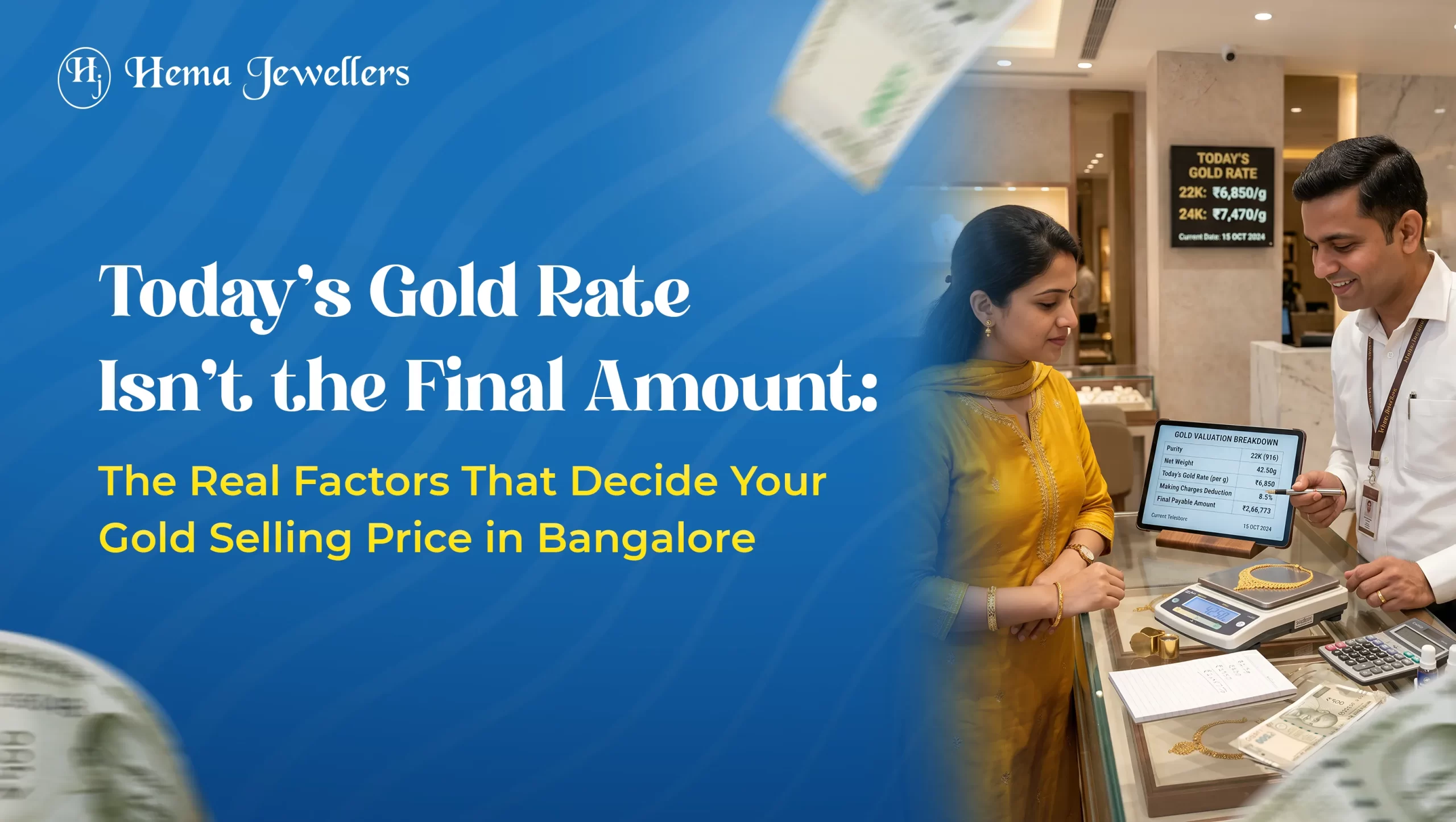
This gap between the published rate and the final payout is one of the most misunderstood aspects of gold selling in Bangalore. The good news is that it is not mysterious. Every rupee of difference has a reason, and knowing those reasons puts you firmly in control of the transaction.
Table Of Contents:
- Why the Published Gold Rate Is Only a Starting Point
- Factor One: Karat Value and Purity Assessment
- Factor Two: The Weight After Deductions
- Factor Three: Buyer Margin and Operational Costs
- Factor Four: Making Charges Are Not Recovered
- Factor Five: Local Market Conditions and Buyer Demand
- Factor Six: Payment Mode and Its Hidden Cost
- What a Transparent Valuation Should Look Like
- How Hema Jewellers Ensures You Receive Every Rupee You Deserve
- Knowing the Difference Between a Fair Deal and a Manipulated One
- FAQs
Why the Published Gold Rate Is Only a Starting Point
The gold selling rate today in Bangalore that appears on financial websites, jeweller boards, and commodity exchanges reflects the price of 24 karat pure gold per gram under ideal market conditions. It is a benchmark, not a guarantee.
Your gold jewellery, in most cases, is not 24 karat. It contains alloys. It may have stones. It has been worn, shaped, and crafted into a form that requires evaluation before pricing. The journey from that published number to your final payout involves several legitimate and some not-so-legitimate adjustments, depending on who you are selling to.
Understanding each factor gives you the power to distinguish between a fair deduction and an unfair one.
Factor One: Karat Value and Purity Assessment
The single largest variable in your gold’s selling price is its purity. Here is how the math works in practice:
24 karat gold is 99.9% pure. The rate you see on commodity platforms applies here directly.
22 karat gold is 91.6% pure. The applicable rate is 91.6% of the 24 karat rate.
18 karat gold is 75% pure. You receive 75% of the base rate per gram.
14 karat gold is 58.5% pure, and the calculation follows accordingly.
If your jewellery is 22 karat and the buyer assesses it as 18 karat, you immediately lose the value equivalent of 16.6% purity on every single gram. This is why purity testing must be done transparently using calibrated equipment, not estimated visually or assumed from appearance.
BIS hallmarked jewellery carries a government-certified purity mark that offers legal protection against karat misrepresentation. Non-hallmarked pieces require XRF testing, which is a non-destructive, accurate method that produces an instant reading. Any buyer who skips or rushes this step at the point where you sell gold for cash in Bangalore deserves scrutiny.
Factor Two: The Weight After Deductions
Weight is the second pillar of your gold’s price calculation. But the weight that matters is not what your gold showed on the scale the moment it was placed. What matters is the net gold weight after all legitimate subtractions.
Here are the standard deductions and what is acceptable versus excessive:
- Stone weight deduction: Any embedded precious or semi-precious stones, diamonds, rubies, emeralds, or synthetic stones must be subtracted from gross weight since they hold no gold value. A transparent buyer removes stones where possible and weighs separately. Where removal is not feasible, standardized weight charts are used. An overestimated stone deduction is one of the most common ways sellers are quietly shortchanged.
- Alloy content adjustment: Gold alloys contain copper, silver, or zinc to increase durability. For 22 karat gold, 8.4% of the weight is non-gold material. This is already factored into the karat-based rate calculation and should not be deducted again as a separate charge.
- Wastage or melting loss charges: Some buyers levy a wastage fee, claiming gold is lost during melting. At the point of selling, no melting has occurred. This charge, when applied to outright gold purchases, is not a legitimate deduction and is a red flag.
Factor Three: Buyer Margin and Operational Costs
Every business operates with a margin. Gold buyers are no different. When you search where can I sell gold near me, you will find buyers ranging from large jewellery chains to small independent counters. Each has different overhead costs, and these influence the margin they need to maintain.
A large, well-established jeweller with certified equipment, trained staff, and regulatory compliance will offer rates very close to the live market rate because their operational credibility is its competitive advantage.
A small, unlicensed counter may offer a slightly higher initial number to attract sellers, but then recover that margin through inflated deductions during the weighing and assessment process.
The margin itself is not dishonest. The manner in which it is applied determines whether a buyer is transparent or exploitative.
Factor Four: Making Charges Are Not Recovered
This surprises many first-time gold sellers. When you originally purchased your jewellery, you paid making charges on top of the gold value. These charges covered the artisan’s skill, design work, and craftsmanship. When you sell, making charges are not part of the calculation.
The buyer pays for the gold content only. This means that a heavily crafted piece with intricate design, which may have cost significantly more to purchase because of high making charges, will be valued purely on its metal content when sold.
Understanding this in advance prevents the frustration of expecting a sale price that includes craftsmanship value. It also explains why coin gold and bar gold tend to yield better per-gram returns than jewellery, as they carry minimal or zero making charges in their purchase price.
Factor Five: Local Market Conditions and Buyer Demand
The gold selling rate today in Bangalore can also be influenced by local demand cycles. During festival seasons, wedding months, and periods of high gold buying activity, some buyers tighten their purchase margins because they have strong retail demand to fulfil. During slower periods, competitive buyers may offer slightly better rates to maintain transaction volumes.
This is a smaller variable compared to purity and weight, but it is worth knowing. Selling during a period of high local gold demand can occasionally yield marginally better outcomes when working with buyers who reflect market dynamics in their pricing.
Factor Six: Payment Mode and Its Hidden Cost
Not all payment modes are equal from a value perspective. Some buyers offer:
Cash payments that are immediate but may be subject to TDS deduction above certain transaction thresholds as per Income Tax regulations.
Bank transfers are traceable, safe, and preferred for larger transactions.
Partial cash and partial cheque arrangements can complicate record-keeping.
Under Indian tax law, gold sale transactions above Rs. 2 lakhs require PAN details and attract TDS in specific conditions. A trustworthy buyer will explain these requirements clearly rather than using them as leverage to reduce the offered rate. When deciding where to sell my gold in Bangalore, always confirm the payment method and any tax implications before finalizing.
What a Transparent Valuation Should Look Like
A fully transparent gold sale produces a written document that includes every variable. Here is what that document should show:
- Gross weight of the item as measured on the certified scale.
- Stone weight deduction with individual stone weights listed.
- Net gold weight after stone deduction.
- Karat value as confirmed by XRF or hallmark reading.
- Applicable rate per gram based on live market data at the time of transaction.
- Final calculated value before any buyer margin.
- Final offer amount with buyer margin clearly stated.
- Payment mode and applicable tax deductions, if any.
If a buyer cannot or will not produce this breakdown in writing, the transaction lacks the transparency that every seller deserves. This standard of documentation is not extraordinary. It is the minimum that reputable buyers maintain.
How Hema Jewellers Ensures You Receive Every Rupee You Deserve
At Hema Jewellers, our pricing process is built around one commitment: no seller leaves without fully understanding how their offer was calculated. Here is how we deliver on that:
Certified XRF purity testing is conducted openly in front of you, with the reading shown and explained.
Calibrated digital weighing with the display fully visible throughout the process.
Live market rate reference updated at the start of every business day and adjusted for significant intraday movements.
Itemized valuation documents are provided before any commitment is made, giving you the freedom to compare.
Zero unexplained deductions: Every subtraction is named, justified, and shown in the written breakdown.
Immediate payment in your preferred mode, with full clarity on any applicable tax requirements.
We serve sellers across Bangalore who come to us with jewellery in every condition, from pristine, hallmarked pieces to old, broken, or unworn gold that has been sitting in lockers for decades. Every gram is treated with the same rigour and the same respect.
Knowing the Difference Between a Fair Deal and a Manipulated One
The gold market in Bangalore is large, competitive, and unfortunately, inconsistent in its standards. Some buyers are genuinely committed to fair pricing. Others rely on seller unfamiliarity to quietly reduce payouts through opaque processes.
The most powerful thing you can bring to any gold transaction is knowledge. Know the live rate. Know your gold’s karat. Know the approximate weight. Know what deductions are legitimate. And know that you have every right to ask for a written breakdown before accepting any offer.
When you walk into Hema Jewellers, you are walking into a space where that knowledge is welcomed, not discouraged. Because we know that an informed seller who receives a fair, transparent offer becomes a lifelong customer and a trusted referral in their community.
Your gold has a precise, calculable value. Make sure you receive it.
The gold market in Bangalore is large, competitive, and unfortunately, inconsistent in its standards. Some buyers are genuinely committed to fair pricing. Others rely on seller unfamiliarity to quietly reduce payouts through opaque processes.
The most powerful thing you can bring to any gold transaction is knowledge. Know the live rate. Know your gold’s karat. Know the approximate weight. Know what deductions are legitimate. And know that you have every right to ask for a written breakdown before accepting any offer.
When you walk into Hema Jewellers, you are walking into a space where that knowledge is welcomed, not discouraged. Because we know that an informed seller who receives a fair, transparent offer becomes a lifelong customer and a trusted referral in their community.
Your gold has a precise, calculable value. Make sure you receive it.
FAQs
1. Why is my final payout lower than the gold selling rate today in Bangalore that I checked online?
The published rate applies to 24-karat pure gold. Your jewellery’s karat, stone deductions, and buyer margin all reduce the final figure. A transparent buyer explains each adjustment clearly.
2. Can I negotiate the rate when I sell gold for cash in Bangalore?
Yes. If you know the live market rate and your gold’s purity, you are in a strong position to negotiate. Reputable buyers respect informed sellers and price competitively.
3. Are the charges refunded when I sell gold jewellery?
No. Making charges paid at the time of purchase are not recovered during a sale. Buyers pay only for the metal content, regardless of the jewellery’s design or craftsmanship.
4. What long-tail factors should Bangalore residents research before deciding where to sell their gold in Bangalore to get the most accurate and highest payout possible?
Sellers should research the buyer’s purity testing method, scale certification, deduction policies, live rate usage, payment options, and customer reviews. Buyers who score well across all these factors consistently deliver the most accurate and highest payouts.
5. Is XRF testing safe for my gold jewellery when I look for where I can sell gold near me?
Completely. XRF testing is non-destructive, takes under a minute, and does not alter the jewellery in any way. It is the most accurate purity testing method available and should be standard at any reputable buyer.